|
|
DEAL
or NO DEAL …..Verify a 1965 – 1966 Mustang Factory GT
GT package includes:
-Front fog Lights
-‘A’ or ‘K’ code engine
-Tight ratio steering box
-Front non-power disc brakes, rear drums
-Dual exhaust pipes run through rear valance ends in trumpet
tips
-GT badges and stripe / bright rocker molding and quarter
panel trim deleted
-Special handling package with large diameter sway bar;
heavy duty front coil and rear leaf springs
-Five-dial instrument cluster instead of rectangular Falcon
style on the 1965 cars

Let’s start with the easy stuff. A quick walk around of this black car shows
GT badge’s and stripes.
On GT’s (and all
Fastback cars, both GT and non GT) the bright trim on the rear quarter panel is
deleted.
On an impostor GT there might be evidence of the removed Pony emblem, script, quarter trim and rocker
panel molding as found on this regular production car. Look for holes that have been filled in for the mounting pins. It’s hard to tell unless we remove the front fender and look at the unpainted backside. Reproduction fenders (that have been put on fake GT cars) won’t have the holes so unless we know the car has an original fender it’s not a definitive check.

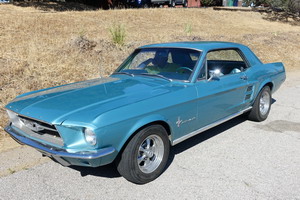
Here is a close up of the Pony emblem and Mustang script
found on non GT cars, like the green one directly above.
The lettering is attached at the bottom, making the script
one contiguous piece.

Here we have the GT badge and stripe. Each individual letter of the Mustang logo was on a separate pin. It would be nice if we could pull the fender to see if the holes for the logo were factory punched … I don’t think the owner would be too happy with us! The rear of the car shows the dual
‘Trumpet’ exhaust coming out the rear valance panel and the GT
emblem on the gas cap. You could
order all the other options described in this article separately,
but not the exhaust through the valance. It
was an exclusively part of the GT package.

Look at the rear valance and frame
rails to see if there is any evidence that the car used to have the vertical
bumperettes bolted onto the car.
If so, that should set off some alarms. They can’t be installed with the exhaust pipes
properly routed through the valance, and were not offered on the GT

The front was distinguished by fog
lights. These could be installed on any car as a dealer option.
We will talk more about the fog
light switch and wiring later.
The last interior items to check are the
disc brake pedal and the fog light switch. The pedal will have bright trim
and say “Disc Brake” on it. The fog
light switch is located on the lower dash on the far left side. Reach behind and unscrew the keeper that holds
the switch to the dash. The GT fog light switch had a D-shaped hole. Most
people drill a round hole for the switch.
Let’s open the door and examine
the data plate. It is a stamped metal
tag located on the on the inside of
the driver’s door, near the latch
mechanism.

Here we have a 1965 plate. There
are many references that will help you decode the numbers and letters, including
http://www.mustangdecoder.com/decoder.html This is an original Prairie Bronze color car
with the ‘A’ code engine. Look at the
“14E” build date of the car. The planned build date for the car was April
28, 1965. The GT package became available in mid April of 65, so allowing
for some lag time if a car has a planned date earlier than February 1965 it
is not a factory GT.
The VIN (warranty) number should
match the one stamped under the hood, and be substantiated by DMV records. The VIN by itself and corresponding DMV
records will not designate the body style, color or any other info, and will
not document the car as a GT. The VIN will tell us which of Ford’s three factories
(San Jose, Metuchen or Dearborn) made the car, and what engine was
installed There are companies that will
stamp and sell you a reproduction plate complete with correct four slit ‘star’
pattern rivets. Therefore we have to
rely on the under hood fender apron stamp (substantiated by DMV historical
data) to make sure a subject car was made with an ‘A’ or ‘K’ code engine. These
were the only engines available with the GT package.

This data plate looks to be in suspiciously
good shape. It is a reproduction. The font at
all three assembly plants for the 1965 model year was larger as shown in the
previous door data plate. The fonts for other years varied. Another way to tell if a tag is original is
to look at the axle and trans codes. The two numbers are right were one would
assume that they should be. Ford, however, did not do it like that. On the
first (burgundy) tag and on the (blue) one below, you’ll notice that the two
numbers are shoved together underneath trans, almost like a two digit code for
trans, leaving axle blank. That’s how most original tags are. You can pay a
little extra and get a reproduction tag made that way. If the codes are like
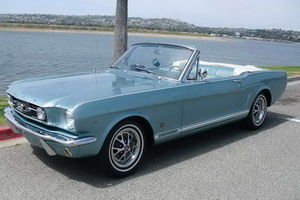
the one on this D code convertible, it is most likely a reproduction. .

The layout of the 1966 plates
changed. The warranty (VIN) number was moved to the top.
It has the same information as the
earlier plate.
There are no Ford VIN number records or additional information for 1965 1966 cars. We are left on our own to decide if the dataplate is original and authentic, and to make an educated guess as to whether a car is a factory made GT. For 1967 and later cars there are records. Kevin Marti has a long standing relationship with Ford Motor Company. He has acquired and organized all the 1967 and later production data, and is licensed by Ford to provide the information to owners. If you have what you believe to be the authentic VIN number of a car you can contact him via http://www.martiauto.com and get the ‘Marti Report’ for your car. Kevin has personally spoken to a computer programmer at Ford who said, "I'm the guy who pushed the button that erased all the '66 data." No one has records for the 1965 and 1966 cars.
Now let’s open the hood…..…..


On the driver’s side fender apron
you will find a notch with a stamped eleven digit VIN number. The fifth digit should be an ‘A’ code for the
289 V8 engine with 4 barrel carb, or a ‘K’ for the high performance
version. The star symbols before and
after the VIN made it harder to alter the numbers.
This stamp is the legal record of
the VIN on the car. In most states it is
illegal to alter, change, remove or restamp it without DMV or Police
oversight. There are stamps hidden in
two other locations. One is on the passenger fender apron, under the fender
lip. The third is near the hood hinge on the driver’s side, again under the
fender lip. The front fenders must be unbolted to see these other VIN number
stamps.
Since VIN numbers are corroborated
by DMV records, one would have to have a junk car with records to provide
paperwork for an altered car. In a cars 40 year history it is possible that the
VIN numbers on a car have been forged. There are reports of scam artists taking
the ‘identity’ of a rare hi-performance K code car (from a rust bucket or a car
that was in a horrible crash) and transferring it to a less valuable, altered
car.
Sway bar
|
|
|
Refer back to the previous
picture, find the sway bar. This car does not have the power steering unit
blocking
access so it is easy to reach down
to it. Take a micrometer or calipers and measure the diameter. If you don’t
have a micrometer, see if a 3/4” open end wrench will fit over it.
The GT cars (and all ‘K’ code cars, GT or not) had the ‘handling package’
with heavy duty suspension, and larger diameter sway bar.
The regular sway bar measures 5/8
“, the heavy duty version is a tad fatter, over 13/16”
Steering box, Brakes &
Master Cylinder
Take a look at the single pot
master brake cylinder; the GT and all front disc brake cars used an oversize
cylinder with a clip on cap; drum brake cars had a screw on cap. You can
purchase a new (aftermarket or rebuilt) master cylinder, so it alone does not
prove or disprove an original disk brake car. Also, many original disc brake
cars have been modified and fitted with a later, safer two pot, two brake
circuit system.
Note the old proportioning valve
that distributes brake fluid in the correct volume and pressure to the front
and rear brakes. Below is
a picture of the valve removed
from the car.
![]() |
You will have to get underneath the car for a good look at the Kelsey Hayes disk 4 piston brakes.
|
Below the master cylinder find the
steering box. We are looking for the letters HCC AX (tight ratio 16:1 manual)
or HCC AW (16:1 power steering). Most
of the GT cars came with the HCC AX tight ratio box.
The box takes some work to change; the tag does not.
A brand new tag can be purchased and then ‘aged’. One sure way to tell
if a car has the tight ratio box is to jack the front up and count the number
of steering wheel turns it takes to go from stop to stop....3 3/4 turns from
lock to lock with the tight ratio manual (or automatic box), and about 4 and
a half turns with HCC-AT. If
a car has the HCC AX (or to a lesser extent the AW box) we are on the right
track! An HCC AT 19:1 ratio manual steering box is not a good sign.
Note: All of the '65-'66 power steering boxes were the 16:1 ratio, there is really no such animal as a "tight ratio" power steering box.
Below are some more examples of steering box tags that have been removed form the box.

Fog Lights
There has been a lot of talk about
the proper size and shape holes in the radiator supports that routed the fog
light wires from the grill towards the wiring harness and the dash. The
consensus is that there were two 11/16” two holes made at the factory for the
wiring.


Here are the details of the fog light
holes on both the drivers and passenger’s side.
|
Take a careful look at the back side of the holes. This one has a slight bevel around the edge. The hole has most likely been punched at the factory, as opposed to drilled in someone’s garage. I have seen the holes punched and drilled on factory GT’s….so it is not 100% proof of a factory fog light car. If you come across one that does have the bevel it is a really good indicator, though. |
The gauge and glove box bezels are particular to the GT (and Pony Interior) cars. ’65 non-GT cars had a rectangular speedometer face, see below. The ’65 and ’66 GT cars both had round dial speedos. The black border stops halfway down the face. The Pony Interior cars have fake wood grain decals. Instrument bezels and glove boxes are easily changed; this indicator by itself does not verify a true GT.
UPDATE: Look at the 1966 GT instrument bezel and glove box pictures below. I have reports that some 1966 (non-pony interior) GT cars have original bezels with black border going all around the face; same as the non-GT cars (which means 1966 GT non-Pony Interior might have the bezels shown in # 3 and # 6 below).

On a 1965 model car with the GT package or Pony Interior,
there will be a round cut in the dash along the bottom to accommodate the
round speedo. A car that came with the rectangular Falcon-style instrument
cluster will be straight across the bottom.
All the 1966 cars had the round
cut (both GT and non-GT cars had the round speedo).
The ammeter gauge in a 65 GT or pony
interior car is different from a 66 model car. The ammeter gauge does not
have the two posts sticking out of the back of it, like a 66. It has a metal
loop sticking out of the back, and the main power feed wire ( black
with a yellow stripe) passes through that loop and the gauge sense the direction
of current flow. So, a 65 GT car, if you pull the instrument cluster out a
little bit, should show the dip in the dash and an ammeter gauge that has
no wires plugged directly into it. (NEED PICTURE)
Dual Exhaust Hangers
The next item is going to involve a little work.


Sit in the rear of the car &
face the back seat. Push the seat bottom
in and tilt it up.
Look under the seat back for the
small metal backings for the dual exhaust hangers.
The floor pan sheet metal is
reinforced in this entire area.
Here is a better picture with the
entire seat back unbolted and removed. You can see
The double reinforced sheet metal
that encompasses the exhaust hangers & seat belt anchors
There is another check for factory
dual exhaust. From under the car look at the rear frame rails, where the rear
exhaust hanger attaches, just ahead of the shackle. There should be a metal
bracket towards the rear, between the inside rails where the hanger bolts
go through the frame. The bracket was welded during production of the car
so that the exhaust hanger bolt wound not crush or deform the rail. You can
feel the bracket by inserting your pinky finger into the hole and feeling
towards the rear of the car.

You can also check for the bracket by opening
the trunk and sticking your finger through the hole on the top of the rail. There is a tubular
bar down inside the hole. If you stick your finger under and
Here is a close up view of the
hole in the trunk where you will check for the plate it will be under the tubular bar.
Conclusion & Referances
There are other details that one
can check to help determine if a car is
a factory GT. These
include the presence (or absence) of factory wiring for the fog lights, markings
or stamps that distinguish FoMoCo parts (for the GT options such as foglights,
or correct bezels) from aftermarket parts.
Some non-GT cars had many of the
GT options, and were completed at the dealership as GT ‘s with 1960’s vintage
factory made parts. For the purist, these are not ‘factory’ GT cars. There are
ways to determine with absolute certainty that a car is not a factory GT:
1) If the car has a scheduled
build date earlier than February of 1965, it is not a factory GT.
2) If the car is not a K code or
an A code, it is not a factory GT.
3) If a 1965 model car does not
have a clean, factory cut in the dash bottom for the speedo, it is not a
factory GT. Having the dip does not mean that it definitely is a GT…the dip is
also found on 1965 Pony Interior cars.
4) If the car does not have the
reinforcement inside the rear frame rail for the exhaust hanger and behind the
rear seats, the car is not a factory GT (unless the unibody has been altered).
5) If the car does not have
cutouts in the radiator support for the fog lights, it is not a factory GT.
As for the other bolt on features (steering box, foglights, suspension components),
the presence or absence of any one of these does not prove or disprove that
a car is an original GT. A non-GT car might have been ordered and factory
built with some of the options included in the GT package. The 1965 Pony Interior
cars came from the factory with the bezel dip. Other cars had options added
at the dealership or after the car was sold. The bottom line is this:
For the 1965 and 1966 cars there are no Ford Motor Company records
matching VIN numbers with original build information.
Unless there is original 1960’s documentation, like a Buck Tag
( can be ordered as stamped reproductions) or Build Sheet proving irrefutably
that a car is a factory GT, a judicious buyer is left to his own devices to
examine a car and foster an opinion whether or not it is a factory GT.
_______________________________________________________________________________________
Thanks to Veronica Sczbecki for contributing
to this article. She has lots of excellent, practical early Mustang info on her blog http://thecareandfeedingofponies.blogspot.com
Thanks to Kevin Marti for reviewing this article, and for his comments. For more detail about how to spot a fake data plate tag, and information on decodingthe engine, transmission, buck, VIN, and all other tags on your car see his
Mustang and Cougar Tagbook
http://www.martiauto.com/itemselection.cfm?id=1964
Please do not copy or quote any
part of this article without express permission
Questions, comments suggestions,
corrections? Mail to:
ss@mustangdreams.com
Other references and articles:
http://www.kcode.net/GT65-66.htm
http://www.angelfire.com/film/fly4fude/actic.html
http://www.mustangmonthly.com/howto/mump_0001_how_to_spot_a_fake_65_66_gt/index.html
|
|